Secrets Of Mosfet Cross Reference and Replacement Guide
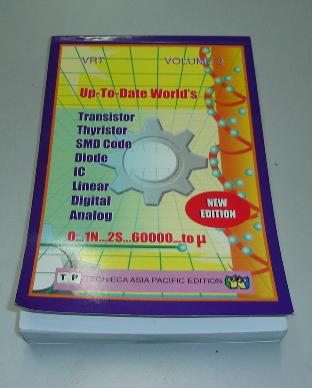
A Semiconductor Replacement Guide Searching for the right mosfet cross reference or datasheet, one has to look for a semiconductor transistor replacement data book and not the Philip ECG master replacement guide. Almost all the transistor replacement book will published out the specification of a particular components such as type of component it belong whether it is a fet, scr, bipolar transistor, horizontal output transistor and also the voltage, ampere, wattage, ohm, frequency and suggested substitution part number.
From my experienced, the substitution part number that was recommended by the data book is not always 100 % match. If you have the time, I would like to suggest to you that, find the right part number by yourself rather than depending on the transistor data book.
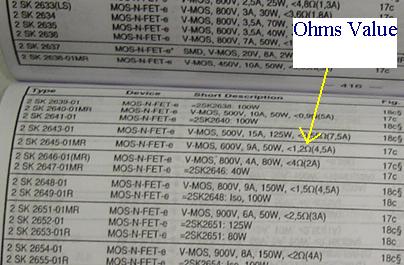
It is the same when you look for horizontal output transistor (HOT) specification which doesn't mean that the bigger specification, the better the substitution part number is. In searching for Mosfet cross reference, you have to look at the ohms value which is provided by the transistor data book besides the specification of voltage, ampere and the wattage. The replacement, besides the same or higher in voltage, ampere and wattage, one should also consider the ohms value. The ohms value has to be as close as possible.
Arrow is showing the mosfet ohms value in a transistor substituion book
If the original fet part number is 1 ohm then a good replacement mosfet must have the ohm values between of 0.5 to 1.5 ohm. Do not substitute it with a too high or too low ohms value as this will make the mosfet run warmer and eventually blow the mosfet itself. Even though you can get a replacement with a higher voltage, ampere and wattage, if the ohms value is too low or too high, the mosfet will still burnt after on for quite a while.
It runs well for sometimes before it breakdown again. After two weeks the customer brought back the printer with the same complaint which is no power. Upon checking the power side I found the same mosfet gave up again. Substituting with another mosfet part number that have a similar specification especially the ohms value solved the printer no power symptom.
Specification with larger voltage, ampere and wattage don’t guarantee that the replacement mosfet will work. So, taking the mosfet ohms value into consideration, you will have a higher chances to repaired the equipment and sometimes the replacement mosfet will also last longer.
|
|
Iandeks Obrabotka Informatsii 3 Klass Matveeva Prezentatsiia 【SAFE · 2024】
Visual aids, such as presentations, are indispensable for teaching this topic. A well-structured presentation allows students to see the "black box" of processing in action. Using diagrams with arrows showing the flow from "Input" to "Processing" to "Output" makes abstract concepts tangible. Interactive slides that challenge students to categorize data or predict outcomes based on a set of rules turn a passive lesson into an active cognitive exercise.
The Matveeva textbook emphasizes that processing can happen in two main ways: by changing the form of the information or by changing its content. Changing the form might involve taking a verbal description of a weather report and drawing a chart; the facts remain the same, but the presentation is different. Changing the content involves logical reasoning to find something unknown, such as solving a puzzle or a logic task. This distinction helps students understand that "thinking" is a structured process that can be analyzed and improved. iandeks obrabotka informatsii 3 klass matveeva prezentatsiia
Information processing is essentially the change of the input data into a new form or the creation of a new result. For a nine-year-old, this concept is best illustrated through everyday activities. When a student reads a mathematical word problem and calculates the answer, they are processing information. When they translate a sentence from one language to another or follow a recipe to bake a cake, they are engaging in the same logical sequence: receiving input, applying rules, and producing output. Visual aids, such as presentations, are indispensable for
In conclusion, studying information processing in the third grade is not just about computers; it is about developing logical thinking and mental discipline. By mastering the concepts presented in the Matveeva curriculum, students gain the tools necessary to navigate an increasingly data-driven world. They learn that information is not just something to be stored, but a dynamic resource that can be transformed to reveal new insights and solutions. Changing the content involves logical reasoning to find
Copyright@ 2006-2014-www.ElectronicRepairGuide.com All Rights Reserved